Are Your Old Seeds Still Good? How to Test Germination Before Replacing a Packet
Before buying new seeds, test a small sample from an older packet. Learn how to run a paper-towel test, calculate the result, and use it without assuming it guarantees garden performance.
Test old seeds before deciding whether to replace them
A quick sample test can turn an uncertain packet into a more informed planting decision.
Yes—older seeds may still be worth planting, but age alone cannot tell you whether a particular packet will sprout. Seed age and storage conditions both matter. Before buying replacements, test a small sample using a moist paper towel, then use the result alongside the crop’s directions and how many plants you need. University of Illinois Extension describes this as a practical household check, while also noting that sprouting is not the same as producing a vigorous seedling.
The test answers a limited question: under the conditions you provide, how many seeds in this sample sprout? It does not prove that every seed in the packet is alive or that seedlings will thrive in your garden. Still, it can help you decide whether to sow the packet as usual, sow more seeds than you need, or replace it before planting time.
Gather a small sample and simple supplies
Keep the setup modest, labeled, and easy to check so the result is useful rather than confusing.
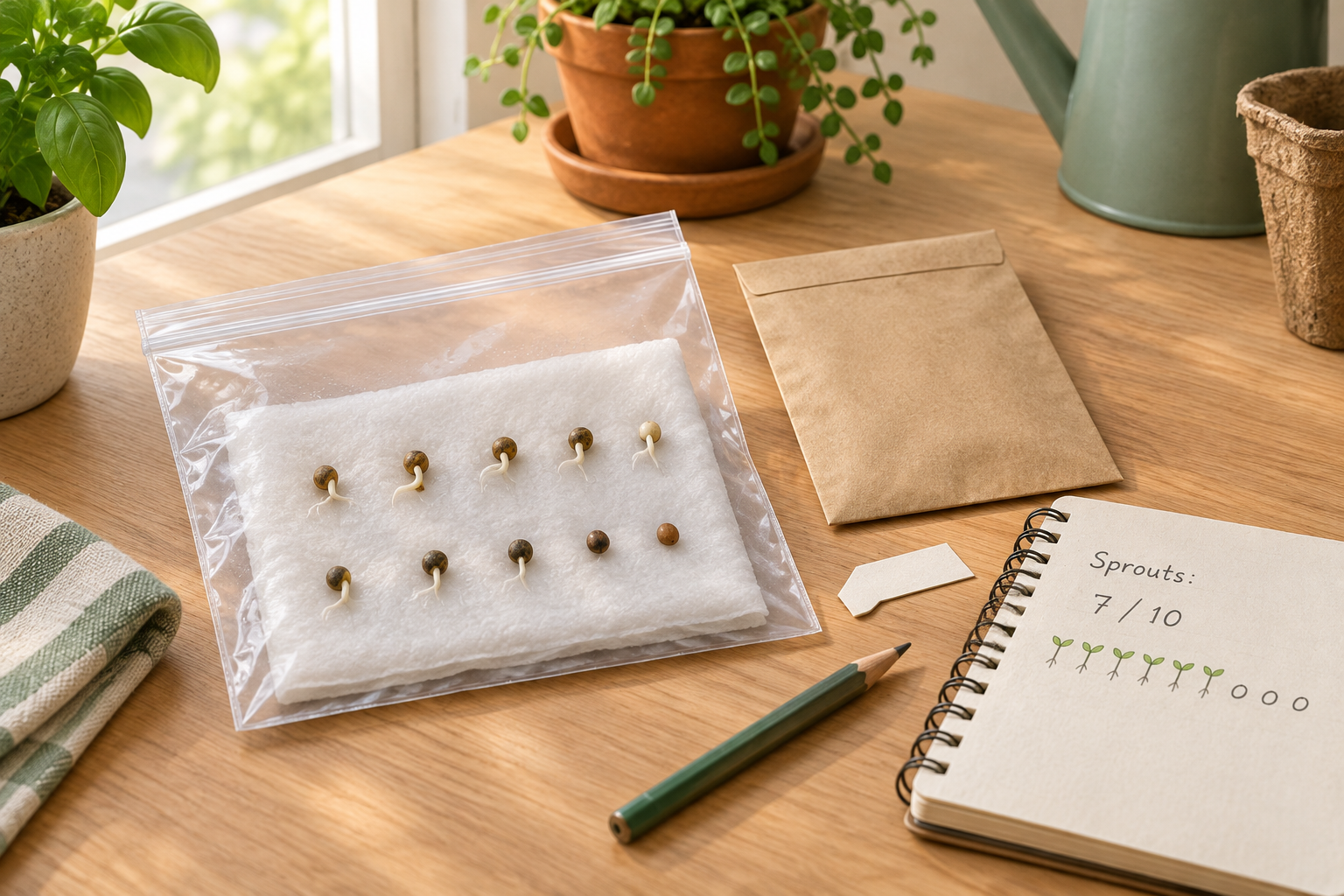
For a basic test, gather 10 seeds, a clean paper towel, water, a sealable plastic bag or small container, and a pen or label. Ten seeds make the calculation easy: each seed represents 10 percentage points. If the packet contains only a few precious seeds, avoid using a large share of them; a smaller sample is possible, but each seed has a bigger effect on the result and the estimate becomes less dependable.
Write the crop or variety and test date on the bag or a note beside it. If you are testing several packets, keep each sample separate. Mixing seeds or forgetting which packet they came from can make the result hard to use when it is time to plant.
Run the paper-towel germination test
Provide moisture and a suitable environment, then check against the seed’s own germination guidance.
Moisten the paper towel so it feels damp throughout, but is not dripping or sitting in a pool of water. Place the seeds with a little space between them, fold the towel over them, and put it in the labeled bag or container. For this simple version, close the bag to help keep the towel from drying out. Illinois Extension describes a sealed-bag setup; other extension guidance uses different arrangements, so this is one practical method rather than a universal laboratory protocol.
Keep the sample in a warm place appropriate for the crop, away from direct sun and heat sources that could dry it out or overheat it. Check periodically. If the towel is drying, add a little water; if it is waterlogged, improve the setup rather than leaving seeds submerged. Look at the packet or crop-specific guidance for the expected germination conditions and timing. Different plants can take different amounts of time, so do not assume every test should be finished after the same number of days.
When a seed visibly sprouts, count it. If you are unsure how long to keep checking, use the packet’s germination guidance or a crop-specific extension resource. Don’t count a seed as a failure merely because it has not sprouted as quickly as another kind of seed.
- Label the sample before you start.
- Dampen the towel and space the seeds across it.
- Fold the towel, place it in the labeled bag or container, and keep it in a suitable warm location.
- Check periodically, maintain moisture, and record the number that sprout.
Calculate the result—and understand its limits
The arithmetic is straightforward; the uncertainty comes from how representative the sample is.
Calculate germination percentage by dividing the number of seeds that sprouted by the number tested, then multiplying by 100. If 7 of 10 seeds sprout, the result is 7 ÷ 10 × 100, or 70%. If you test 20 and 14 sprout, that is also 70%. A count is helpful even when the sample is small, but it should not be mistaken for a precise measurement of every seed remaining in the packet.
With only 10 seeds, one seed changes the result by 10 percentage points. The packet may also contain a mix of seeds that have been stored under slightly different conditions. Utah State University Extension discusses larger samples, such as 25–50 seeds, in its guidance. A larger sample can give a more informative estimate if you have enough seeds to spare; for a home gardener, 10 is a convenient first check, not a claim that this is the only valid sample size.
There is another limitation: germination is not seedling vigor. A seed may sprout but produce a weak seedling. The paper-towel test also does not recreate all the challenges of garden soil, weather, pests, or watering. Treat the result as a planning clue, not a promise about harvest or garden performance.
Decide whether to sow normally, sow extra, or replace the packet
Match the result to the crop, your space, and the cost of a poor stand rather than relying on a single cutoff.
There is no one germination percentage that is right for every gardener or crop. The useful decision depends on how many plants you need, whether you can spare space to sow extras, how much seed remains, and what the packet or crop guidance says. Utah State Extension’s guidance includes minimum germination-rate context that varies by vegetable; it should not be turned into a universal rule for all seeds and situations.
For example, imagine you need six healthy seedlings and a test of 10 seeds produces seven sprouts. That 70% result suggests some seed is viable, but not that exactly seven out of every 10 remaining seeds will grow. If you have room and enough seed, you might sow extra and thin or transplant as appropriate for the crop. If you need a dependable number of plants in a small space, replacing the packet or testing a larger sample may be the more practical choice.
A packet that produces few or no sprouts may be a candidate for replacement, but first consider whether the test conditions suited that species. If you do plant an older packet, label the sowing and monitor emergence so you can act promptly if the stand is sparse.
| Test result or situation | Possible next step | Keep in mind |
|---|---|---|
| Many seeds sprout and you have room to adjust | Sow the packet as directed, or sow a modest extra amount if appropriate | The sample may not represent every seed remaining. |
| Some seeds sprout, but you need a reliable number of plants | Consider testing a larger sample or replacing the packet | Check crop-specific guidance and the amount of seed you can spare. |
| Few or no seeds sprout | Review the test conditions and any special requirements; retest or replace if needed | A basic test can fail when the method does not meet a seed’s needs. |
| The seeds are scarce or valuable | Use a smaller sample only if losing those seeds is acceptable, or follow crop-specific advice | A very small sample gives a rougher estimate. |
Check for special germination requirements
A failed basic test may reflect dormancy or unsuitable conditions, not necessarily dead seed.
Some seeds need specific conditions before they germinate. One example is cold, moist stratification. If a species requires a period of chilling or another treatment, placing it in a warm, damp towel may not be an appropriate test. Illinois Extension cautions that special germination requirements can affect results.
Before treating a low count as a reason to discard a packet, read the packet and look up crop-specific guidance from a reliable extension service. Follow the instructions for that plant rather than trying to make one paper-towel setup work for every seed type. If the packet is missing its name or variety, the uncertainty is greater: a general test may not reveal the conditions it needs.
Record the result and plan your next sowing
A short note now makes next season’s seed choices easier and reduces repeat guesswork.
Keep a simple record with the crop and variety, packet date if known, test date, sample size, number sprouted, and any special conditions used. For example: “Bush bean, packet marked 2024, tested March 3; 7 of 10 sprouted; paper towel kept damp in a warm room.” This is more useful than writing only “old seeds okay,” because you can see exactly what the result represents.
Use the note when planning how much to sow, but continue to follow the packet’s planting depth, spacing, and timing guidance. If you replace the packet, keep the test result as a reminder of what happened to the old one. If you sow it, label the row or tray and check emergence before deciding whether to add seed or adjust your plan.
The practical next step is simple: choose one older packet, check whether the species needs special treatment, test a small labeled sample, and calculate the sprouts. Then make a crop-specific choice about sowing, sowing extra, testing more seed, or replacing the packet.
Frequently asked questions
How many seeds should I use for a germination test?
Ten is convenient for a household check because the percentage is easy to calculate, but a larger sample can give a more informative estimate if you have enough seed. Extension recommendations differ: Illinois describes a 10-seed setup, while Utah State discusses samples of 25–50. A small sample is only a rough guide to the rest of the packet.
How long does a paper-towel seed test take?
It depends on the crop and test conditions. Check the seed packet or crop-specific guidance for expected germination timing and conditions; there is no single finish time for every seed.
What does 7 out of 10 seeds sprouting mean?
It means the sample’s germination percentage is 70%: 7 divided by 10, multiplied by 100. It does not guarantee that 70% of every remaining seed will sprout or that the seedlings will thrive in the garden.
Should I throw away seeds that do not sprout in the test?
Not automatically. First check whether the crop needs conditions such as cold, moist stratification and whether the sample had suitable moisture and temperature. If conditions were appropriate and few seeds sprout, replacing the packet may be practical, depending on how many plants you need.
Can old seeds sprout but still grow poorly?
Yes. Germination measures whether seeds sprout, not how vigorous the resulting seedlings are. Observe growth after planting and consider the growing conditions as well as the test result.
Sources & further reading
Explore the original sources behind this article. Our editorial perspective is separate from the organizations we reference.