How to Plan Thanksgiving Dinner With One Oven: A Backward Schedule
Coordinate a Thanksgiving turkey and sides with one oven by working backward from serving time, mapping each recipe’s oven needs, and planning safe make-ahead and holding options.
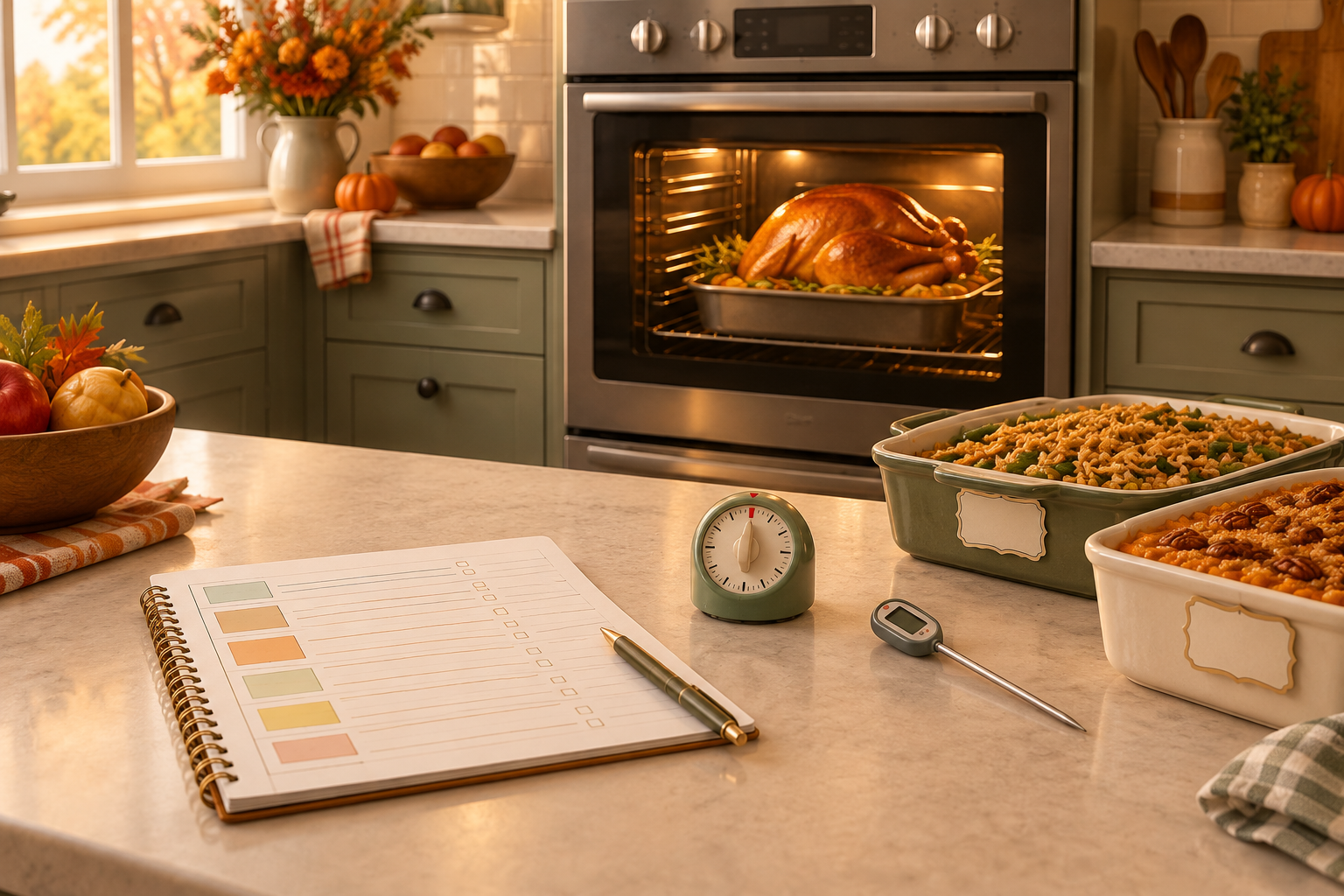
Start your one-oven Thanksgiving schedule with serving time
A useful plan is a sequence of flexible oven slots, not a promise that every dish will finish at an exact minute.
To plan Thanksgiving dinner with one oven, choose a realistic serving time, list each dish’s cooking requirements, and work backward to assign oven slots. Schedule the turkey according to its recipe and size, then fit sides around its temperature and likely finish window. Make suitable dishes or components ahead, and leave room for timing changes. There is no universal minute-by-minute schedule: oven performance, pan size, recipes, and turkey size all affect cooking. Alabama Cooperative Extension likewise recommends planning backward from serving and treating sample timelines as general guidance because cooking times vary.
Write down when guests should sit down, then decide what “ready” means for each dish: freshly baked, reheated, or fully cooked and safely held. Give yourself a transition buffer for tasks such as changing the oven temperature, moving pans, checking the turkey, and setting the table. The buffer is a planning choice, not additional cooking time that can replace a recipe’s instructions.
- Use the recipe’s stated temperature and time as the starting point—not a generic Thanksgiving chart.
- Plan for food to be ready near serving, rather than requiring every dish to come out of the oven simultaneously.
- Keep the schedule adjustable until the turkey is confirmed done.
Inventory oven space, pans, and other equipment
A dish can fit the timeline on paper and still fail to fit the oven in practice.
Before choosing an oven order, check what will physically fit. Note the size and number of pans, which rack each recipe needs, whether dishes can share a rack, and whether you can still close the door without crowding. Check your oven’s instructions if you are unsure about rack positions or using multiple racks. Also account for the turkey’s roasting pan: it may occupy most of the available space even if a side dish’s cooking time overlaps on paper.
Make a menu inventory with one row per dish. Include the recipe’s oven temperature, estimated cooking duration, whether it can be made ahead, and whether it needs the oven at the last minute. Record non-oven methods too. A stovetop pot, microwave, or another appliance may take pressure off the oven if the recipe and equipment are suitable. University of Maryland Extension advises considering oven space and other equipment while planning, and preparing suitable dishes ahead.
- Measure or test-fit pans before Thanksgiving Day.
- Mark dishes that need a specific temperature, uncovered baking, or a particular rack.
- Identify sides that can be finished on the stovetop or reheated in another suitable appliance.
Build the oven sequence around the turkey
The turkey usually sets the largest oven block, so plan around its requirements while keeping side dishes independent of an exact finish time.
Start with the turkey’s package instructions or a reliable recipe that matches its weight and preparation. Put its planned oven temperature and estimated cooking window on the schedule. Do not treat the estimate as a doneness test: use a food thermometer and follow current safe-temperature guidance. FoodSafety.gov’s chart lists safe minimum internal temperatures, including 165°F for poultry. For a whole turkey, use a trusted guide for where to check; the site’s separate turkey-temperature instructions can help with probe placement.
Next, place sides that require a different oven temperature into slots before or after the turkey, but only if their own recipes allow that timing. Some baked dishes can be assembled ahead and cooked later; others depend on a particular texture or temperature and are best baked close to serving. Avoid assuming that changing a recipe’s temperature or extending its time will work—the result depends on the dish.
If a side must bake while the turkey is in the oven, verify that both recipes allow the same temperature and that the pans fit with room for air circulation. If not, choose another slot or method rather than forcing both dishes into the oven.
- Schedule the turkey using its recipe’s estimated timing, with a separate thermometer check for doneness.
- Assign each side a specific oven slot and note when the temperature must change.
- Treat recipe temperature changes as a reason to check the recipe, not as an automatic shortcut.
Work backward from serving with a simple worksheet
A written schedule makes conflicts visible before the kitchen is busy and gives you a place to note fallback plans.
Use the worksheet below with your own recipes. Replace “recipe time” and “recipe temperature” with the instructions for each dish. The slots are planning labels, not suggested cooking durations. Once you enter your intended serving time, count backward from it and reserve enough time for any recipe-specific rest, finishing, or reheating instructions.
For example, if the turkey’s estimated finish window overlaps with a casserole’s only suitable oven slot, decide before the day whether the casserole can be assembled ahead, baked earlier and reheated, or made by another method. If none of those options fit its recipe, change the menu or serving plan. That is easier than discovering the conflict when the turkey is already roasting.
- Write the target serving time at the top of the page.
- For every dish, record its oven temperature, estimated cooking time, pan size, and any make-ahead instructions.
- Schedule the turkey’s oven block using its recipe; mark its finish as an estimate pending a thermometer check.
- Place each side in an oven slot that matches its recipe and the available space.
- Add transition time for temperature changes, checking food, and moving pans.
- Write a backup for any dish whose timing depends on the turkey finishing on schedule.
| Dish | Recipe temperature and time | Pan or oven-space needs | Prep-ahead option | Planned slot and serving plan |
|---|---|---|---|---|
| Turkey | Use the recipe for this bird | Roasting pan; note rack and space | Follow recipe and food-safety guidance | Main oven block; confirm doneness with thermometer |
| Casserole | Copy from recipe | Pan size; rack position | Assemble ahead only if recipe permits | Before or after turkey, or reheat as directed |
| Vegetable side | Copy from recipe | Pan size; uncovered or covered | Prep components ahead if suitable | Oven, stovetop, or other suitable method |
| Dessert or rolls | Copy from recipe | Pan size; temperature needs | Prepare ahead if recipe permits | Schedule outside the busiest oven window |
Move suitable preparation to the day before
Make-ahead work helps most when it removes a task from the oven schedule rather than simply shifting it to another crowded moment.
Choose dishes or components that can be prepared ahead without compromising the recipe. Depending on the dish, that might mean washing and cutting vegetables, measuring ingredients, mixing a dressing, or assembling a casserole for later baking. Follow the recipe’s storage and reheating directions, and keep perishable ingredients refrigerated as appropriate. University of Maryland Extension’s holiday checklist supports planning some dishes ahead to reduce work on the day.
Label prepared dishes with their oven temperature, estimated heating time, and any final steps. This prevents a chilled dish from being mistaken for one that is already cooked or ready to serve. For reheating, use a food thermometer and follow current food-safety guidance; FoodSafety.gov lists 165°F for leftovers. The appropriate method and timing can vary by food and recipe, so do not assume a dish is ready because its surface looks hot.
- Prepare ingredients ahead when full make-ahead cooking is not suitable.
- Store and label dishes so the next step is clear.
- Put reheating instructions on the schedule, separate from the dish’s original cooking time.
Plan for the turkey to finish early or late
A schedule works better when sides can wait briefly or move to another method without compromising safety or quality.
Turkey timing is an estimate, not a fixed appointment. Build a buffer around its expected finish and avoid scheduling every side to depend on the exact moment it comes out. If the turkey is not done when expected, keep following its recipe and check doneness with a thermometer; serve sides according to their own safe preparation and holding needs. If it finishes earlier than planned, use a safe hot-holding setup rather than leaving cooked food at an uncontrolled temperature.
FoodSafety.gov advises keeping hot foods above 140°F and cold foods below 40°F. Slow cookers, warming trays, and chafing dishes can hold fully cooked food hot, but they are not for cooking food. Use a thermometer to check temperatures and follow the equipment’s instructions. Do not rely on a covered dish, a warm room, or touch alone to establish that food is being held safely.
- Keep a thermometer available for both doneness checks and temperature monitoring.
- Use holding equipment only for fully cooked food, not to finish cooking raw or undercooked dishes.
- If you cannot maintain safe holding conditions, adjust when the dish is served instead of guessing.
Make your final plan usable on Thanksgiving Day
A short, visible run sheet can keep the cooking order clear even when the original timing shifts.
Put the schedule somewhere easy to see and include tasks beyond oven time: preheat, temperature changes, thermometer checks, resting or finishing steps required by the recipe, and serving. Write the intended equipment for each dish—oven, stovetop, microwave, or hot-holding appliance—so two foods do not quietly claim the same space.
Before guests arrive, confirm that pans and serving dishes are ready, ingredients are available, and the oven is clear. On the day, update the plan when the turkey’s progress changes. Move a flexible side to a later slot or use a suitable non-oven method if needed; do not skip a safe-temperature check to preserve the original timetable. For more specific guidance on thawing, turkey probe placement, or leftovers, consult those food-safety instructions separately rather than relying on this scheduling guide.
- Keep the recipe instructions close to the schedule.
- Mark which tasks can move and which are tied to a specific temperature or texture.
- Review your plan before shopping or prep so you can change the menu if oven capacity is unrealistic.
Frequently asked questions
When should I put the turkey in the oven for Thanksgiving dinner?
Use a reliable recipe that matches your turkey’s size and preparation to estimate its cooking window, then work backward from your serving time. Treat that time as an estimate and confirm doneness with a food thermometer; do not rely on the clock alone.
Can I bake side dishes at the same time as the turkey?
Only if the recipes’ temperatures, pan dimensions, rack needs, and oven capacity are compatible. If one dish requires different conditions, schedule it before or after the turkey, prepare it ahead if appropriate, or use another suitable cooking method.
Can I make Thanksgiving sides the day before?
Many recipes allow some ingredients or dishes to be prepared ahead, but the method differs by dish. Follow its storage and reheating instructions, label what remains to be done, and use a thermometer when reheating.
How do I keep Thanksgiving food warm while the turkey rests?
Use a suitable holding appliance for fully cooked food and monitor its temperature. FoodSafety.gov advises keeping hot foods above 140°F; slow cookers and warming trays are for holding cooked food hot, not for cooking it.
Sources & further reading
Explore the original sources behind this article. Our editorial perspective is separate from the organizations we reference.
- [S1] Timing Is Everything: Plan Ahead for a Stress-Free Thanksgiving Dinner - Alabama Cooperative Extension Systemaces.edu
- [S2] An 8-Day Holiday extension.umd.edu
- [S3] Your Holiday How-To: Keeping Hot Foods HOT and Cold Foods COLD | FoodSafety.govfoodsafety.gov
- [S4] Cook to a Safe Minimum Internal Temperature | FoodSafety.govfoodsafety.gov