Travel Adapter or Voltage Converter? Check Your Devices Before You Fly
A plug adapter changes the connection, not the electricity. Check each device’s voltage and frequency ratings against every destination before packing.
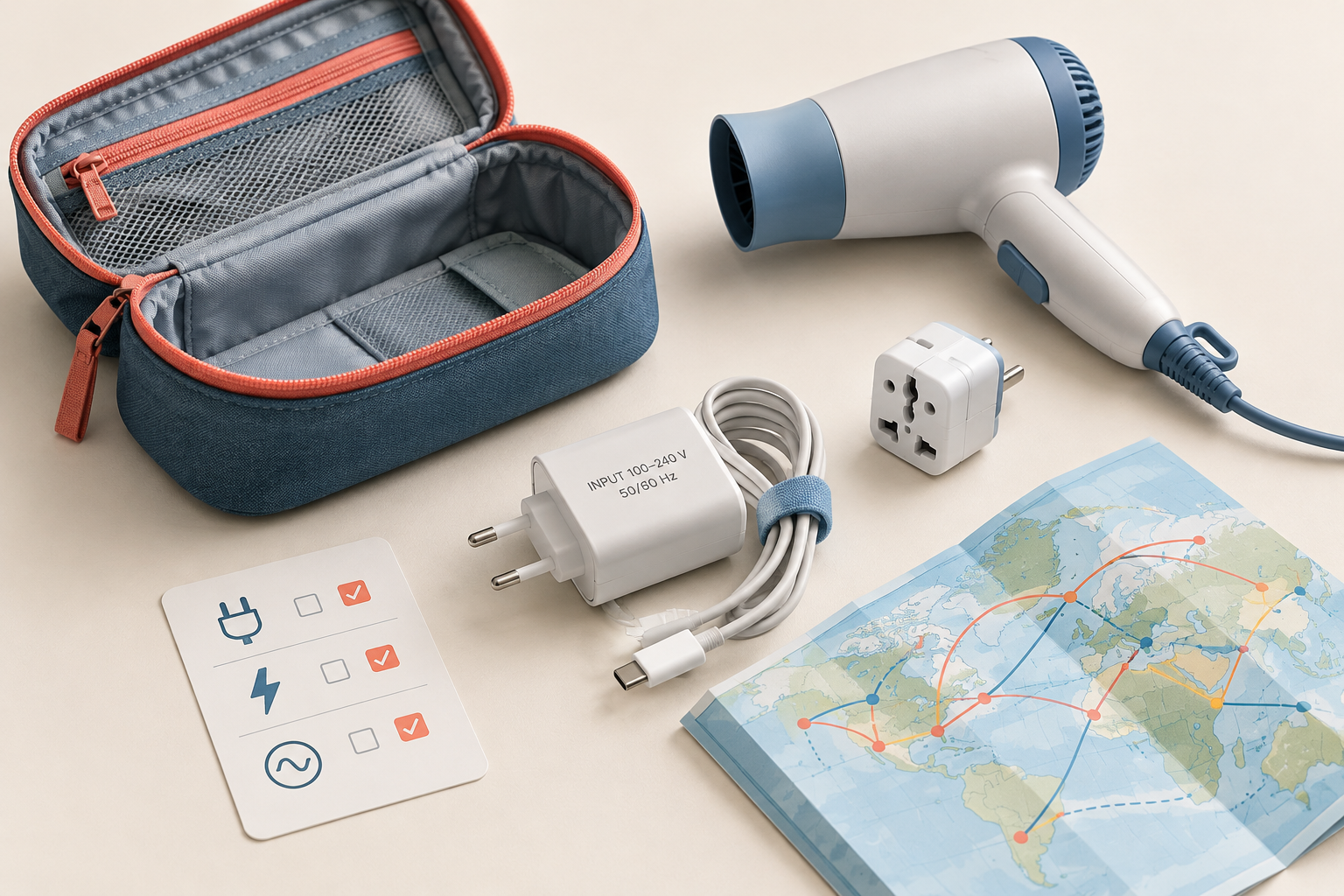
Travel adapter or voltage converter: check the plug and power separately
A plug that fits the outlet is only one part of the compatibility check.
To choose what to pack, check two things for every charger or appliance: whether its plug can connect to the outlet, and whether the device supports the destination’s electrical supply. A travel plug adapter can change the physical connection. It does not change voltage or frequency, so it cannot make an incompatible device suitable by itself.
Find the input rating on the device, charger, or power supply and compare it with the voltage and frequency where you plan to use it. If the stated range covers the local supply, an appropriate plug adapter may be all you need—but follow the manufacturer’s instructions and check any other ratings or restrictions.
This distinction helps you pack only what you can verify: perhaps a suitable adapter for a charger that supports the destination’s supply, and a different plan for an appliance whose rating does not.
Start with every destination on your itinerary
A setup that works in one country may not suit another stop.
Write down each country where you expect to plug in a device. Include a layover if you will leave the airport or need to use an appliance there. Outlet shapes and electrical supplies vary by destination, so do not assume that one adapter or one electrical setup will cover an entire multi-country trip.
For each stop, check the outlet type and local electrical supply using reliable, destination-specific information. The U.S. Department of State advises travelers to bring power adapters and chargers appropriate for their destination. Treat that as a reason to check your route and equipment, not as a recommendation for a particular product.
A universal or multi-country adapter may accept several plug shapes, but that feature alone does not tell you whether a device supports local voltage and frequency. Nor does it establish that the adapter is suitable for a grounded plug or a high-power appliance. Read its ratings and instructions, and check each destination separately.
- List destinations and any stopovers where you will use electricity.
- Record the outlet type and electrical supply information for each stop.
- Keep those details alongside your packing list so you can match the adapter and devices to the right destination.
Read the input label on each charger and appliance
Use the exact model’s markings, not a general assumption about a product category.
Look for “INPUT” on the charger, power brick, appliance nameplate, or manufacturer’s documentation. The label may show a voltage range—for example, “100–240 V”—and a frequency, such as “50/60 Hz.” Compare both with the destination’s supply and follow any additional instructions or limits. Check the exact model: similar-looking products can have different specifications.
A voltage range that includes the destination voltage indicates that the device is designed to accept that range, but it is not a reason to ignore frequency, grounding, power ratings, or manufacturer restrictions. A label with only one voltage should not be treated as universal. If the label is missing, worn, or unclear, look up the exact model in the manufacturer’s official instructions or ask its support team.
As a brand-specific example, Apple says its USB power adapters support 100–240 V AC at 50–60 Hz. That information applies to the adapters covered by Apple’s guidance, not to every charger or device. Check the markings and documentation for the equipment you will actually bring.
- Check the power supply as well as the device it charges; the relevant input rating may be printed on the supply.
- Note voltage and frequency, plus any other operating limits shown.
- Do not infer compatibility from a familiar brand, a USB port, or a plug that physically fits.
Choose an adapter, converter, or alternative
Let the device’s ratings and instructions—not the product name—determine what you need.
If the device supports the destination’s voltage and frequency, and its instructions allow use there, a plug adapter may be appropriate when the plug shape differs. Select one whose ratings and design suit the device, including any grounding requirement. Electrical Safety First emphasizes that an adapter does not convert voltage or frequency and advises checking the outlet and appliance ratings.
If the device’s voltage rating does not cover the destination’s supply, do not connect it directly. Conversion equipment may be an option only when the device manufacturer permits it and the converter’s instructions and ratings explicitly suit that device and intended use. Do not assume a voltage converter also changes frequency. Some appliances have requirements that a basic converter does not address.
When you cannot establish a suitable match, use a confirmed alternative: leave the appliance at home, borrow or buy a device made for the destination, or ask your accommodation whether an appropriate appliance is available. Confirm arrangements rather than relying on an assumption.
- Never force a plug or remove a grounding pin to make it fit.
- Do not use an adapter or converter beyond its stated ratings or contrary to its instructions.
- Stop using equipment if it is damaged, unusually hot, sparking, or behaving unexpectedly. Disconnect it if safe, and do not continue until the issue is resolved.
| What you find | What to verify | Practical next step |
|---|---|---|
| The input rating includes the destination voltage | Frequency, adapter fit, grounding needs, and manufacturer instructions | Use a suitable plug adapter only if the remaining checks are also satisfied. |
| The input rating does not include the destination voltage | Whether the manufacturer allows conversion and whether the converter is rated for this exact use | Do not plug it in directly. Use conversion equipment only if compatibility is confirmed. |
| The label is missing or unclear | Exact model documentation or guidance from the manufacturer | Do not guess; use a confirmed alternative or leave the device behind. |
| The adapter or converter rating is unclear or below the device’s needs | The equipment’s instructions and ratings, including any load limits | Do not use that equipment for the device. Choose a verified setup. |
Give higher-power appliances extra attention
A small charger and a heating appliance can place very different demands on travel equipment.
Check hair dryers, curling irons, kettles, and other appliances carefully. Read the appliance input label and the adapter or converter rating, then follow the manufacturers’ instructions. A plug adapter that works for a small charger is not automatically suitable for an appliance that draws more power.
Do not use a converter simply because its packaging says “travel.” Confirm that it is appropriate for the appliance’s voltage, frequency requirements, and power demand. Check grounding where relevant, and do not use equipment if its rating or instructions do not clearly cover the intended use. Electrical Safety First recommends checking an appliance’s voltage rating rather than treating an adapter as a conversion device.
For a short trip, leaving a questionable appliance at home may be the simplest option. If you need it, arrange a compatible alternative in advance. This is especially important for equipment you depend on for work or accessibility; do not leave that compatibility check until arrival.
Use a device-by-device packing checklist
A short inventory helps catch one uncertain item before you leave.
Gather the chargers and appliances you plan to use, then match each one to your itinerary. A note or photo of a label can help when it is small, provided you record the exact model so you do not confuse it with another device.
- List every device, charger, and appliance you intend to pack.
- Find the input voltage and frequency on the device, power supply, or official instructions. Note any other ratings or limits.
- Check the outlet type and electrical supply for every destination where you expect to plug in.
- Select an adapter that fits the outlet and meets the relevant ratings and grounding needs.
- If voltage conversion appears necessary, verify the exact device and converter instructions and ratings. Do not assume frequency conversion or universal compatibility.
- Set aside anything with an unclear label or unresolved compatibility question. Ask the manufacturer or take a confirmed alternative.
- Before use, inspect the adapter and cable for damage and follow their instructions.
When you cannot confirm compatibility
A model-specific check is more useful than a trial connection.
Search the manufacturer’s official support information using the exact model number, or contact the manufacturer. Ask whether the device can be used with the voltage and frequency at your destination and whether particular adapter or conversion equipment is permitted. Check the equipment’s own instructions and ratings as well; a compatible device does not automatically make an arbitrary adapter suitable.
If you cannot get a clear answer before departure, do not test the appliance by plugging it in abroad. Leave it behind or arrange a confirmed alternative. For a device you rely on, resolve the question while you still have time to find a suitable option.
Outlet types and electrical supplies depend on destination, while product specifications can differ between models. When planning a new route, check the destinations and devices again rather than relying on a setup that worked on a previous trip.
Frequently asked questions
Does a travel adapter convert voltage?
No. A plug adapter changes the physical connection so a plug can fit an outlet. It does not convert voltage or frequency. Check the device’s input ratings against the destination’s supply.
How can I tell whether my phone charger works overseas?
Read the input label on the exact charger or power supply. Compare its voltage and frequency specifications with the destination’s supply, and follow the manufacturer’s instructions. If the markings are unclear, check the model-specific guidance rather than assuming all chargers are alike.
Do I need a voltage converter for a hair dryer?
It depends on the exact dryer, destination supply, and equipment ratings. Check the dryer’s label and instructions, and use conversion equipment only if the manufacturer permits it and the converter is explicitly suitable for the intended use. If you cannot confirm that, do not plug it in; take a compatible alternative.
Can one universal adapter work for a multi-country trip?
It may fit several outlet shapes, but that does not establish voltage or frequency compatibility, grounding, or suitability for every appliance. Check each destination and device, and follow the adapter’s ratings and instructions.
Sources & further reading
Explore the original sources behind this article. Our editorial perspective is separate from the organizations we reference.
- [S1] Communicating While Abroadtravel.state.gov
- [S2] Electrical Safety Advice for Travel Adaptorselectricalsafetyfirst.org.uk
- [S3] Home Safety - Electrical Safety Foundation Internationalesfi.org
- [S4] About Apple USB power adapters - Apple Support (IE)support.apple.com