How to Use Less De-Icer on Walkways Without Ignoring Ice Hazards
Clear snow first, assess where ice still makes walking unsafe, then use a label-approved product only where needed. Learn how to choose between ice melters and traction materials, and sweep up unused granules.
A careful de-icer routine starts with the walking route
The goal is a usable path, not a blanket layer of granules.
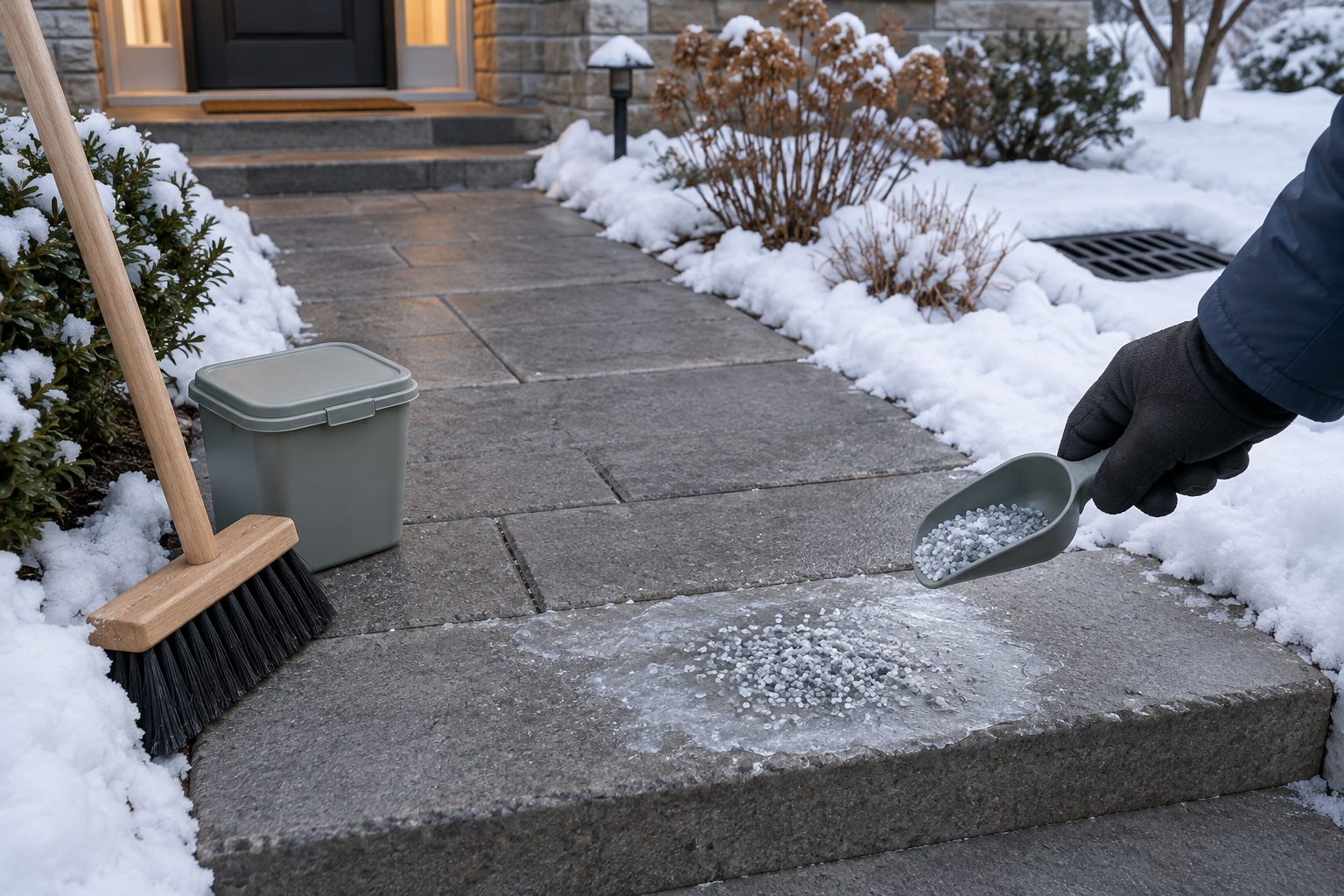
To use less de-icer without ignoring ice hazards, clear away snow first, identify the parts of the walkway that remain slippery, and decide whether melting ice or adding traction is the better next step. If you use a de-icer, apply it only where needed and follow that product’s label, including its temperature guidance. Sweep unused granules from dry pavement for reuse.
Start with the route people actually need: the steps, a path to the door, or the section between a driveway and a sidewalk. A whole driveway or patio may not need treatment if it is not part of the walking route. But do not leave a frequently used, hazardous path untreated just to reduce product use; clear it, choose an appropriate treatment, and consider a temporary safer route if conditions remain dangerous.
Clear snow and loose ice before deciding what to apply
Removing material mechanically can reduce how much product the remaining ice needs.
Shovel or sweep snow from the route before applying de-icer. Where it is safe and practical, scrape away loose or raised ice too. De-icer is not a substitute for clearing a layer of snow, and spreading it over snow can leave you treating more material than necessary.
After clearing, inspect the walking surface rather than assuming it is safe because it looks mostly bare. Thin ice can be difficult to see, especially in shade or near steps. Walk cautiously while checking, and pay special attention to entrances, slopes, and spots where water collects or refreezes.
If you cannot remove all the ice, focus on the part that still creates a slipping risk. On a small set of steps, for example, clear each tread and check for slick patches before deciding whether a label-approved de-icer or a traction material is appropriate. Avoid piling product along the edges as a substitute for treating the walking surface.
Choose between melting ice and adding traction
These approaches address different problems, so choose by the condition underfoot.
A de-icer is intended to help melt or loosen ice; a traction material, such as sand, gives shoes more grip on a slippery surface but does not melt the ice. One is not a direct substitute for the other. If ice remains and you need to remove it, traction material may help with footing while you plan or continue careful clearing, but it does not make the ice disappear.
The most practical choice depends on the surface, the remaining ice, the weather, and the product instructions. Alternatives can have their own drawbacks, including cleanup needs. Penn State Extension distinguishes sand as a traction aid and cautions against assuming alternative materials have no impact.
| What you need | Material type | What to keep in mind |
|---|---|---|
| Help melt or loosen remaining ice | A de-icer labeled for the conditions and surface | Follow the product label, including temperature guidance; avoid treating areas that do not need it. |
| Add grip while ice remains | A traction material such as sand | It adds traction rather than melting ice and may need to be swept up afterward. |
| Remove loose snow or ice | A shovel, broom, or suitable scraper | Clear first where practical, then reassess whether any additional treatment is needed. |
Apply de-icer according to its label
There is no single application amount or temperature threshold that fits every product and condition.
Read the package before spreading anything. Check what surfaces the product is meant for, its temperature guidance, application directions, and any precautions. Products and conditions differ, so do not borrow a rate or temperature from another product or treat a general online rule as a replacement for the label.
Treat only the icy portions of the route that need attention. Avoid creating piles or thick bands: more product is not automatically better. If the ice persists, consult the label before applying more rather than repeating a dose by guesswork. Keep people and pets away as directed by the product instructions.
Be especially cautious near steps, painted or decorative finishes, and surfaces whose compatibility you are unsure about. A product being sold as a de-icer does not establish that it is suitable for every walkway material. Check the label and, if necessary, the surface manufacturer’s care guidance.
Consider plants, hard surfaces, and runoff
The right place to limit excess is around the route—not by accepting a dangerous walkway.
Excessive de-icer can harm nearby plants and may affect some hard surfaces. Keep application focused on the walking area, and avoid scattering material onto planting beds or across the whole driveway when only a narrow path needs attention. If granules land on a dry surface where they are not needed, sweep them up for reuse.
De-icing salts dissolve, and runoff can carry them away from the treated area. The EPA discusses this issue in guidance written for municipal operations; it helps explain the runoff pathway, but it is not a household application manual. For home use, the practical response is to avoid unnecessary spreading and prevent loose material from being washed toward a drain or planting area.
No de-icer or substitute should be assumed harmless simply because it is marketed as an alternative. Consider what the material does, what the label says, and how it will be cleaned up. If safe footing requires treatment, address the hazard with the product or traction method appropriate to the conditions rather than leaving a route dangerously slick.
Sweep up excess and store it for another use
A little cleanup can keep unused material available instead of letting it disperse.
Once the treated surface is dry, sweep up unused granules and keep them in a clean, dry container for reuse if the product remains suitable. Penn State Extension recommends reusing swept-up material, while the University of Minnesota Extension also advises sweeping unused granules from dry surfaces.
Do not sweep wet material into a drain or planting bed. Follow the product’s storage instructions, keep it in its original labeled container when practical, and store it where children and pets cannot access it. If the package is damaged or the product’s identity is uncertain, do not guess about how to use or dispose of it; check its label or seek local disposal guidance.
Use this quick checklist after a snowfall
A short sequence helps balance footing with restrained application.
Before treating the walkway, take a moment to follow this order. If the surface remains unsafe after your first pass, reassess the condition and the product directions rather than applying more automatically.
- Clear snow from the route and remove loose ice where practical.
- Check the steps, slopes, and other sections people need to walk on for remaining slick patches.
- Decide whether the problem calls for ice melting, added traction, or more careful clearing.
- If using de-icer, check the label and treat only the areas and conditions it covers.
- Once the surface is dry, sweep up unused granules for possible reuse and store them as directed.
Frequently asked questions
Should I put de-icer down before shoveling?
The sources for this guide recommend removing snow before applying de-icer. Shovel or sweep first, scrape loose ice where practical, then assess what remains and follow the product label.
Is sand the same as de-icer?
No. Sand is a traction aid: it can add grip but does not melt ice. A de-icer is used to help melt or loosen ice and must be applied according to its label.
How much de-icer should I use, and at what temperature?
There is no universal amount or temperature threshold for every product. Check the directions and temperature guidance on the specific package, and do not use a rate from a different product as a substitute.
Can I sweep leftover de-icer up and use it again?
University and Penn State Extension guidance recommends sweeping unused granules from dry surfaces and reusing them when appropriate. Store them according to the product label and keep them away from children and pets.
Are alternative de-icers harmless to plants and waterways?
Do not assume so. Materials differ, and alternatives can have trade-offs. Use the product label, limit unnecessary spreading, and sweep up unused granules rather than letting them wash away.
Sources & further reading
Explore the original sources behind this article. Our editorial perspective is separate from the organizations we reference.