Window AC in Winter: Remove It, Cover It, or Seal It?
Decide whether to remove your window air conditioner or leave it installed, then reduce drafts with steps that fit your unit, window, and storage options.
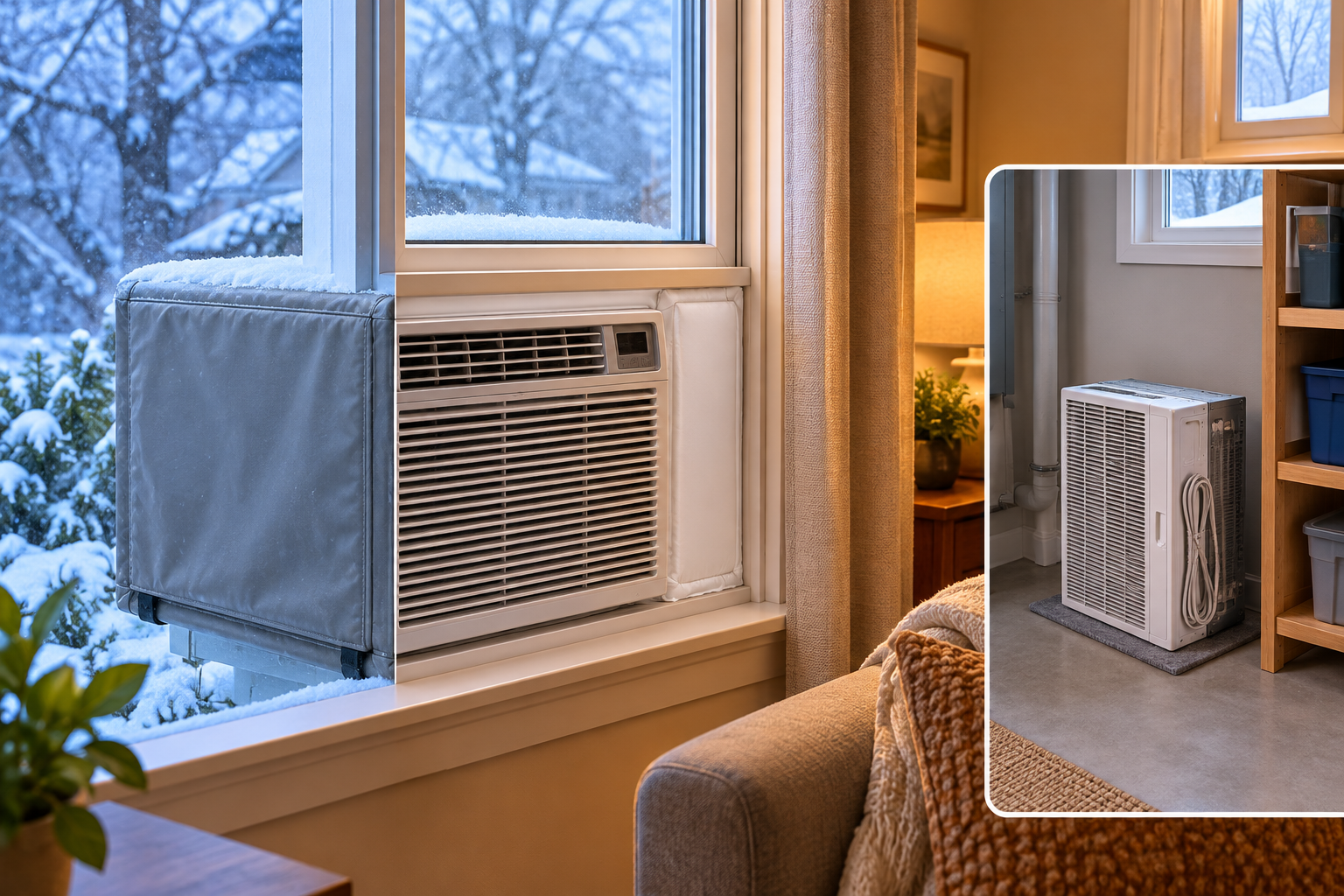
Should you remove a window AC for winter?
The best choice depends on safe handling, storage, the window installation, and your air conditioner’s instructions.
If you can remove the unit safely and have a dry place to store it, taking it out after cooling season is a straightforward way to reduce heat loss through the window. ENERGY STAR identifies removal as an option and says an appropriately sized winter cover is an alternative. If removal is impractical, do not assume the unit can simply be left as-is: check the manual, protect it as directed, and seal air leaks.
The U.S. Department of Energy’s Building America guidance recommends removing the air conditioner or sealing it completely on the inside after cooling season to prevent air leakage through the unit. The fact sheet is dated June 2013, so treat it as general building guidance rather than a replacement for current, model-specific instructions.
In practice, a first-floor unit that is easy to reach and light enough for two people to handle may be a reasonable removal candidate. A heavy unit high above ground, an awkward installation, or nowhere suitable to store it may make leaving it in place the safer choice. A cover alone does not resolve every possible leak or installation issue.
- Consider removal if you can manage the unit safely, the window can be secured afterward, and you have suitable storage.
- Consider leaving it installed if removal would be unsafe or impractical, but use the model’s guidance and plan to limit drafts.
- If you rent, ask the landlord or property manager before altering the installation or exterior appearance.
Make the decision with four checks
A short assessment can prevent a rushed lift or an unsuitable cover purchase.
Before choosing, locate the exact model number—often on a label on the unit—and find its owner’s manual or manufacturer support page. Instructions can differ on whether to cover a unit, how to prepare it for storage, and what cleaning or drainage is appropriate. Do not rely on advice for a different model just because the units look similar.
Next, look at the installation and your own handling limits. Consider the unit’s size, how securely it is mounted, whether the window opens safely, and whether another capable person can help. If removal requires leaning out of a window, working at height, or lifting a unit you cannot control, do not attempt it alone. Arrange qualified help or leave it in place and follow the manual.
Finally, decide where a removed unit would go. Choose a dry, protected storage spot where it can remain in the position the manufacturer recommends. GE Appliances, for example, advises keeping its stored window units upright; that advice should not automatically be applied to every brand without checking its instructions.
| Option | A good fit when | What to check |
|---|---|---|
| Remove and store | You can remove the unit safely and have appropriate storage. | Manual instructions, help for handling, and a secure way to close the window. |
| Leave installed and cover | Removal is impractical and the manual permits a suitable cover. | Cover size and fit, attachment method, and whether indoor sealing is also needed. |
| Leave installed and seal | A cover is unsuitable or unavailable, or drafts remain around the installation. | Seal gaps using a method compatible with the window and unit; check rental restrictions. |
If you remove the air conditioner
Treat removal as a handling and window-securing task, not just a seasonal cleaning routine.
Use the manufacturer’s removal directions for your model and installation. If the manual is unavailable, check the manufacturer’s support resources before improvising. Window units can be heavy and awkward to control; get help if needed, and stop if you cannot keep the unit stable. Do not dismantle brackets or other installation parts unless the instructions call for it and you can do so safely.
After removal, close and secure the window, then address any gaps around the opening using a solution suitable for that window. Keep the unit’s hardware and any removable parts together so they are easier to find at installation time. Prepare the appliance for storage only as its instructions specify: cleaning, draining, or drying procedures are not universal.
Store the unit in the position and conditions specified by its manufacturer. GE Appliances advises storing its units upright. That is a useful reminder to check orientation, not a universal rule for every air conditioner. Avoid placing the unit where it could be knocked over or exposed to damaging conditions.
- Read the model’s removal and storage instructions before starting.
- Arrange help and a safe work position; do not lift or lean out of a window if you cannot control the task.
- Remove the unit according to its instructions and keep hardware together.
- Secure the window and insulate or repair the opening as appropriate.
- Clean and store the air conditioner only as the manual directs.
If you leave it installed: cover and seal thoughtfully
Weather protection and draft control address different parts of the problem.
Start with the manual. If it recommends or permits a winter cover, choose one intended for your type and size of unit, and install it as directed. ENERGY STAR describes an appropriately sized winter cover as an alternative to removing a room air conditioner. GE Appliances also notes that larger units can be covered to protect them from snow and ice. These are general points, not permission to use any cover on any model.
An exterior cover is mainly weather protection. It does not necessarily stop indoor air from leaking through the unit or gaps at the window. From inside, check for noticeable drafts around the sides, top, bottom, and the unit itself. The Department of Energy guidance specifically calls for sealing completely on the inside if the unit remains installed after cooling season.
Use materials and methods compatible with the air conditioner and window. Avoid blocking vents, forcing parts, or applying a seal that could damage the frame, interfere with drainage, or make the unit difficult to remove later. If the unit shifts, appears poorly supported, or the window cannot close securely around it, contact the installer, manufacturer, or property manager rather than trying to compensate with a cover.
- Use a cover only if it is suitable for the model and fits as intended.
- Check indoor edges for air leaks; do not assume an outside cover seals the room.
- Keep vents, drainage paths, and any required clearances unobstructed.
- For a rental, get approval before using exterior attachments or making changes to the window.
Avoid common winterizing mistakes
A few assumptions can lead to unnecessary work or create handling and installation problems.
Do not assume that every unit should be removed, or that every installed unit should be covered in the same way. ENERGY STAR presents removal and an appropriately sized cover as options, while manufacturer directions can vary. The manual for your exact model is the best guide to its preparation and protection.
Do not use a cover as a reason to ignore indoor drafts, and do not seal openings that the manufacturer says must remain clear. Likewise, avoid opening the cabinet, bending components, or pouring water into the unit based on generic online advice. Cleaning and drainage steps depend on the model and its design.
Most importantly, do not attempt a risky lift to avoid a draft. If the unit is too heavy, too high, or insecurely supported, prioritize safe handling. Get appropriate help or leave it installed and address the issue using manufacturer-approved methods.
Check the unit again before spring use
A brief inspection helps you catch storage or winter-protection issues before switching the unit on.
When cooling season returns, consult the manual before reinstalling or uncovering the air conditioner. If it was stored, check its exterior and cord for visible damage and make sure it is positioned as the manufacturer instructs. If it stayed in the window, remove its cover as directed and check that nothing is blocking the unit’s openings.
Before operating it, confirm that the window installation and support are secure and that the unit is set up according to its instructions. If you notice damage, unusual movement, or a problem you cannot identify, contact the manufacturer or a qualified service provider rather than guessing. Keep the manual or model number handy for next winter’s decision.
Frequently asked questions
Is it better to remove a window air conditioner for winter?
Removal can help minimize heat loss, but it is not automatically the best choice for every home. Weigh safe handling and storage against the option of leaving the unit installed, following its manual, and controlling drafts.
Can I leave a window AC installed all winter?
Often, but check the instructions for your exact model. If it stays installed, protect it as directed and address air leaks from indoors; the U.S. Department of Energy’s guidance recommends sealing it completely on the inside after cooling season.
Does an outdoor window AC cover stop drafts?
Not necessarily. An exterior cover can offer weather protection, but drafts may still come through the unit or gaps around its indoor edges. Check and address those separately using a method compatible with the unit and window.
Can I store a window air conditioner on its side?
Check the manufacturer’s storage instructions rather than assuming. GE Appliances advises storing its window units upright, but instructions may differ by model and manufacturer.
Should renters remove a window air conditioner?
Check your lease and ask the landlord or property manager before changing the installation, exterior appearance, or window. If you leave it in place, follow the unit’s manual and use an approved approach to reduce drafts.
Sources & further reading
Explore the original sources behind this article. Our editorial perspective is separate from the organizations we reference.
- [S1] Room Air Conditioners | ENERGY STARenergystar.gov
- [S2] A Homeowner’s Guide to Window Air Conditioner Installation for Efficiency and Comfort (Fact Sheet), Building America Case Study: Technology Solutions for Existing Homes, Building Technologies Office (BTO)www1.eere.energy.gov
- [S3] Window Air Conditioner - Winterizing or Storageproducts.geappliances.com