How to Check Tire Pressure as Temperatures Drop: A Cold-Weather Guide
Find your vehicle’s recommended tire pressure, check each tire when cold, and respond to a TPMS warning with a gauge—not a guess.
Why check tire pressure as temperatures drop?
Cold weather can lower tire pressure, but temperature alone does not explain every warning or low reading.
As outdoor temperatures fall, tire pressure can fall too. A tire that was near its recommended pressure in milder weather may read low on a cold morning. A gauge gives you a reading to compare with your vehicle’s specification; a visual glance is not enough to confirm the pressure.
A tire-pressure monitoring system, or TPMS, can alert you to a problem, but it does not tell you everything about the tire. A warning may appear in cold weather, yet a tire can also lose air for another reason. Check the tires rather than assuming the warning is harmless or temperature-related.
The National Highway Traffic Safety Administration (NHTSA) recommends checking all tires, including the spare, at least monthly when they are cold. Checking before a long trip is also a useful routine.
- A tire can be underinflated even if it does not look flat.
- If a warning turns off after you start driving, check the tires when cold rather than treating the light going out as confirmation.
Find the recommended pressure for your vehicle
The right target comes from your vehicle’s instructions, which may differ by tire position or load.
Look for the tire-information label, commonly inside the driver’s door opening, or check the owner’s manual. Use the recommendation that applies to your vehicle and situation. Some vehicles specify different pressures for front and rear tires or provide guidance for particular loads.
The number printed on a tire’s sidewall is not necessarily the pressure recommended for your vehicle. Use the vehicle label or manual instead of treating the sidewall marking as your target.
Check the spare separately if your vehicle has one. Its required pressure may differ from the road tires, and some vehicles have a compact spare with its own instructions. If the label is missing, the manual is unclear, or the tires do not match the specified setup, ask the vehicle manufacturer or a tire professional which guidance applies.
Measure each tire when it is cold
A cold reading lets you compare the tire’s pressure with the vehicle’s cold-pressure recommendation.
NHTSA defines tires as cold when the vehicle has not been driven for at least three hours. Check before your next trip or wait at least that long after driving. Driving warms tires and changes the reading, so a reading taken immediately after a drive is not directly comparable with a cold-pressure target.
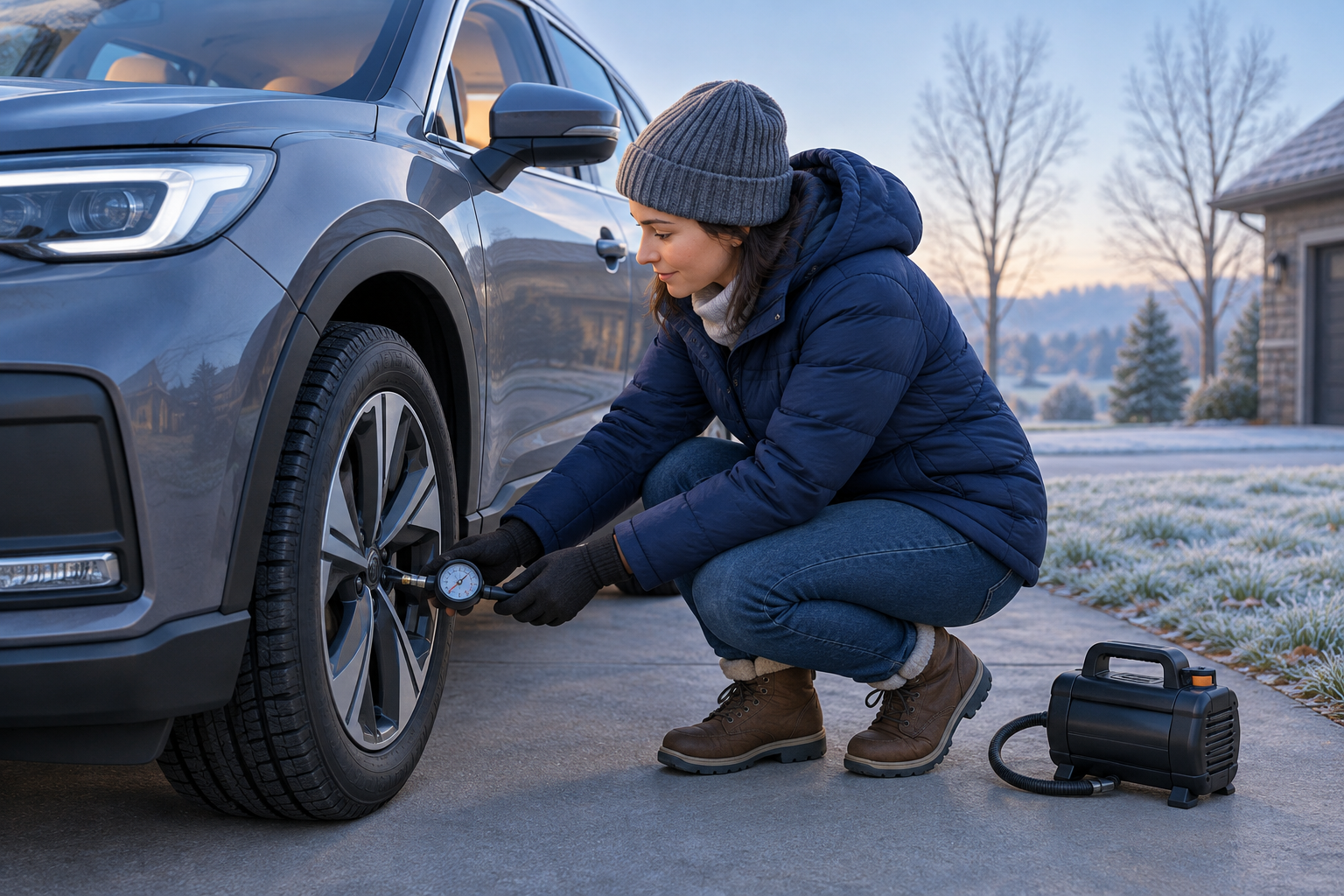
Use a tire-pressure gauge, either handheld or built into an air pump. Park in a safe place, remove the valve-stem cap, and press the gauge firmly onto the valve. A crooked or loose connection can let air escape and give you an unreliable reading. If a number seems surprising, reseat the gauge and measure again.
Check each tire and note which reading belongs to which position; do not assume that tires on the same axle have identical pressure. Check the spare if applicable, then replace the valve caps.
- Park safely and let the vehicle sit for at least three hours, or check before driving.
- Find the recommended pressure for each tire position in the vehicle label or owner’s manual.
- Remove a valve cap, press the gauge onto the valve, and record the reading.
- Repeat for every road tire and the spare, if applicable, then replace the caps.
Adjust pressure using cold readings
Make small, measured changes and recheck; avoid correcting a warm reading as if it were cold.
Compare each cold reading with the vehicle’s specification for that tire. If it is low, add air using a pump or compressor according to the equipment instructions. Add air in short bursts and recheck with the gauge until the cold reading reaches the specified target.
If a cold reading seems higher than the recommendation, confirm it with another careful measurement. If it is still high, follow the vehicle manual or equipment instructions for releasing air, then measure again. Avoid making a large adjustment based on a reading you do not trust.
If you check after driving and the reading is above the cold target, do not release air simply to make the warm reading match that number. Wait until the tires are cold and check again. If the reading is below the target after driving, consult the owner’s manual for vehicle-specific guidance, then confirm and adjust using a cold reading when possible.
If you cannot reach the recommended pressure, cannot identify which specification applies, or notice damage, stop and ask a tire professional for advice.
| What you find | Practical next step |
|---|---|
| A cold reading is below the vehicle’s specification | Add air in short bursts and recheck with a gauge. |
| A reading seems unexpectedly high or low | Check that the gauge is seated correctly, then measure again before adjusting. |
| You checked after driving | Do not release air to match the cold target; check again when the tires are cold. |
| Pressure drops again after you add air | Arrange an inspection rather than relying on repeated top-ups. |
What a TPMS warning does—and does not—tell you
Treat the indicator as a reason to check the tires and the vehicle’s instructions, not as a diagnosis.
A TPMS warning is a prompt to take action, but the exact meaning and display vary by vehicle. Some indicators or messages point to low tire pressure; other warning patterns may indicate a system issue. If the light flashes, another message appears, or you are unsure what the symbol means, consult the owner’s manual.
NHTSA notes that a low-pressure warning may appear on a cold morning and go out after driving warms the tires. Even if it goes out, inspect the tires and measure them when cold. Temperature can be a factor, but it is not a reason to dismiss a warning without checking.
If the manual identifies the warning as a low-pressure alert, measure each tire and compare the readings with the vehicle’s specification. If the warning stays on after you have checked and corrected the pressure, or returns repeatedly, consult the manual and arrange an inspection.
When to seek professional help
Repeated air loss, visible damage, or an unresolved warning calls for more than another routine top-up.
If a tire becomes low again after you inflate it, have it inspected. Repeatedly adding air does not establish why the pressure is dropping, and a professional can assess the tire and advise on the next step.
Pay attention to visible damage such as a cut, bulge, or object lodged in a tire. Do not try to diagnose or repair a damaged tire based on appearance alone. If a tire looks severely deflated or damaged, stop in a safe place and contact roadside assistance or a tire professional rather than continuing on it.
Seek help if you cannot obtain a dependable reading, cannot identify the right pressure specification, or the TPMS warning remains after you have followed your vehicle’s instructions. The owner’s manual provides vehicle-specific guidance about its indicators and operation.
Make tire checks part of your cold-weather routine
A recurring reminder makes it easier to notice changes before a trip or after a warning appears.
Set a monthly reminder to measure the tires when cold, and check them again before a long drive. Keep a gauge accessible and note where the pressure label is or how to find the relevant information in the manual. NHTSA recommends monthly cold checks; Michelin also advises checking when cold and before a long trip.
Follow the same sequence each time: find the vehicle-specific target, measure each tire, add or release air only as needed based on cold readings, and recheck. If a TPMS warning appears between scheduled checks, respond then rather than waiting for the next reminder.
Your next step can be simple: locate the recommended pressure and a gauge, then check the tires before your next drive after the vehicle has been parked for at least three hours.
Frequently asked questions
How long should a car sit before I check tire pressure?
NHTSA defines tires as cold when the vehicle has not been driven for at least three hours. Check before driving or wait that long after a trip before comparing readings with the vehicle’s cold-pressure recommendation.
Should I use the number printed on the tire sidewall?
Use your vehicle’s tire-information label or owner’s manual for its recommended pressure. The sidewall marking is not necessarily the correct target for your vehicle.
Can I ignore a TPMS warning if it turns off after I start driving?
No. A low-pressure warning can go out after driving warms the tires, but you should still inspect and measure them when cold. If you are unsure whether the indicator signals low pressure or a system issue, check the owner’s manual.
Should I let air out if a warm tire reads above the recommended pressure?
Not just to make the warm reading match the cold-pressure target. Wait until the tires are cold and measure again; then use the vehicle’s instructions to decide whether an adjustment is needed.
What should I do if the pressure keeps dropping?
Arrange an inspection by a tire professional. Repeatedly adding air does not establish why the tire is losing pressure.
Sources & further reading
Explore the original sources behind this article. Our editorial perspective is separate from the organizations we reference.