How to Make a Household Emergency Communication Plan Everyone Can Use
Choose shared contacts and meeting places, record key numbers, and agree on backup check-ins so household members know what to try if they are separated.
Make the plan answer one practical question
The goal is not to predict every emergency; it is to help separated household members know who to contact and where to go.
A household emergency communication plan is a shared set of contact details, meeting places, and check-in steps. It should answer: If we are not together, how will we try to reconnect, and what should each person do if the first option fails?
For example, imagine a parent is at work, a teenager is at school, and another adult is running errands when a local emergency disrupts normal routines. A useful plan gives each person the same contact numbers and agreed meeting locations, rather than leaving everyone to guess or rely on memory.
Keep this plan focused on communication. It does not replace local emergency alerts, evacuation instructions, or a broader household preparedness plan. Follow instructions from local authorities for the specific event, since hazards and available services differ by location.
- Keep instructions brief enough to scan under stress.
- Make the plan accessible to everyone who may need it, including caregivers.
- Choose more than one way to check in; no single method is guaranteed to work.
Choose a primary contact outside your area
An out-of-area contact can give household members a shared point of reference when local calls or travel are difficult.
Choose a trusted person who lives far enough away that they are less likely to be affected by the same local disruption. Ask whether they are willing to be the household’s contact, then give everyone the person’s name and phone number. Ready.gov’s family communication plan form includes space for emergency contacts, an out-of-town contact, meeting places, and important numbers.
Agree on what household members should send or say: their name, current location, whether they are safe, and what they plan to do next. Keep the message short and factual. The contact can pass along updates, but should not be expected to coordinate rescue or replace emergency services.
If you cannot reach the first contact, decide who is the alternate. The alternate could be another trusted person who is outside the area. Make sure both contacts know they are listed and understand the limited role you are asking them to play.
- Primary contact: name, relationship, mobile number, and any useful alternate number.
- Backup contact: name and number, if you choose one.
- A simple check-in message: who is contacting them, where that person is, and what they plan to do.
Pick two meeting places everyone can identify
Different locations cover different situations, but each choice should be specific and familiar to the people expected to use it.
Choose one meeting place close to home and another outside your neighborhood. The nearby place might be a clearly identified spot across the street or another safe location your household can reach. The farther location could be a familiar public landmark or a trusted person’s home. The American Red Cross recommends selecting meeting places near home and outside the neighborhood.
Avoid vague directions such as “the park” or “downtown.” Write the exact name and street address, plus a simple description of the spot if the location is large. Consider whether it is accessible to household members with mobility needs and whether children would recognize it.
A meeting place is a pre-agreed option, not an instruction to travel through danger. If authorities give evacuation or shelter instructions, follow those instructions instead. Household members should know that the location may need to change if it is unsafe or inaccessible.
- Near-home meeting place: exact location and a recognizable landmark.
- Outside-neighborhood meeting place: full address and a backup route or description where useful.
- A rule for changing plans: follow official instructions and do not enter an unsafe area to reach a meeting point.
Make contact details available on paper and on phones
A plan is easier to use when it is not stored in just one person’s device or memory.
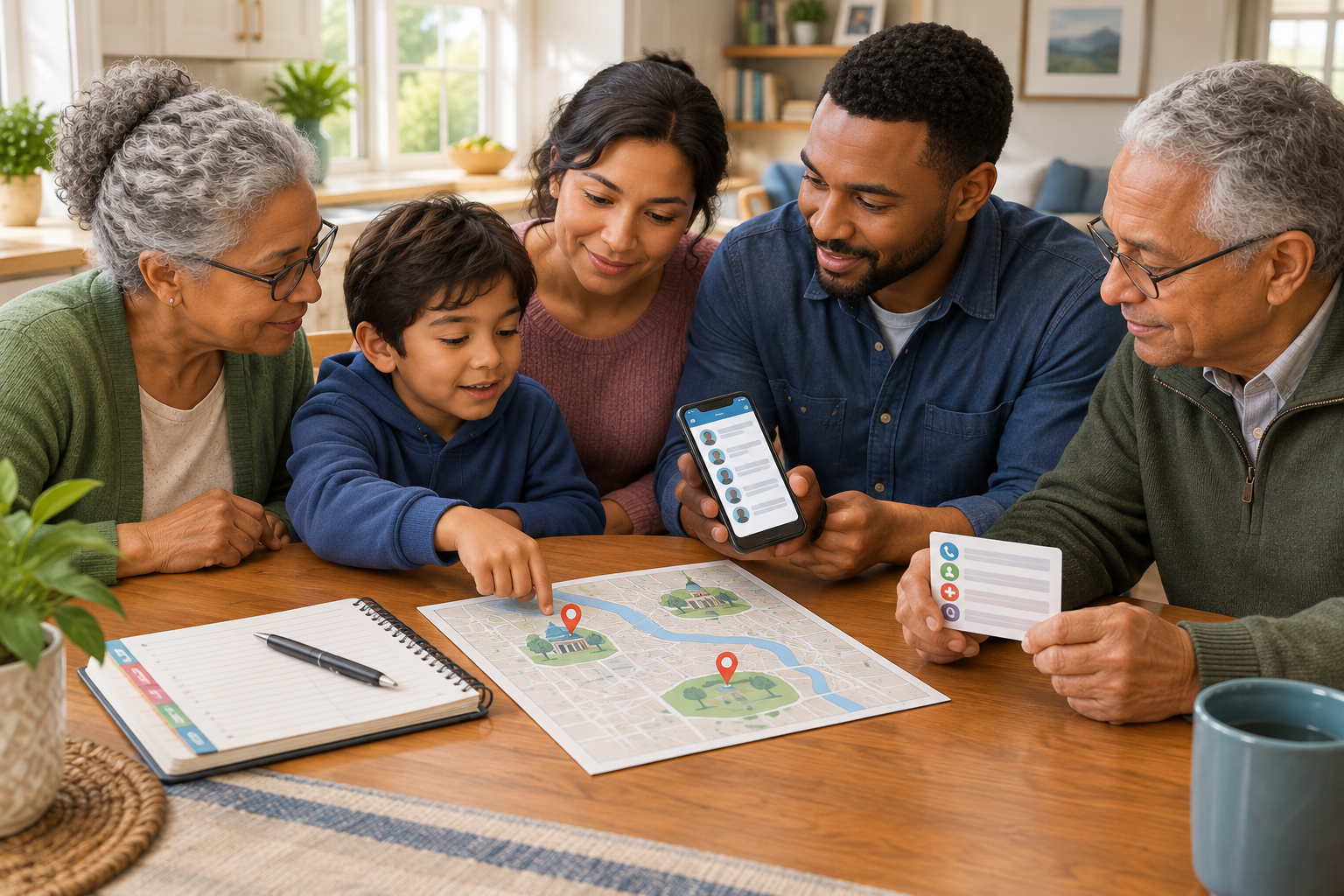
Create a small contact card or one-page plan with names, phone numbers, the out-of-area contact, meeting places, and any agreed check-in instructions. Ready.gov’s form is one example of a template designed to record these details. You can use a printed card, a shared document, or both, as long as household members can access the information when needed.
Save the relevant numbers in each person’s phone, including the out-of-area contact and any alternate. Also keep a written copy somewhere each person can reach it, such as a wallet, backpack, or school bag. The Red Cross recommends keeping contact information written down as well as saved on phones.
Keep the written version concise and readable. If it contains sensitive information, share it only with people who need it and store it thoughtfully. Do not rely on a shared online document as the only copy; access to a device, account, power, or network may be unavailable.
- Include names and relationships so an unfamiliar helper can understand who is who.
- Use phone numbers in a format household members can dial, including area codes.
- Check that printed copies are legible and that phone contacts are saved correctly.
Agree on check-ins and backup methods
A simple sequence reduces guesswork when an attempted call does not connect.
Write down who should contact whom first. For example, each household member might check in with the out-of-area contact, who then shares messages with the others. Or a designated adult might check in with children’s caregivers. Choose a routine that fits your household rather than assuming one arrangement works for everyone.
Agree on what to try next if a call does not connect: send a brief text, wait and try again, or contact the out-of-area person. The Red Cross notes that a text may get through when a call cannot, but that is an option—not a guarantee. A device may have no power or service, and a message may be delayed or never arrive.
If a call or text does get through, share clear information: your location, whether you are safe, and your next intended step. Avoid having everyone repeatedly contact everyone else if that would make the plan confusing. Use the agreed contact chain, and follow local emergency instructions.
- Primary attempt: the contact or channel the household will try first.
- Backup attempt: another agreed option, such as a text or alternate contact.
- Message content: name, location, status, and intended next step.
- A boundary: do not assume silence means someone is safe or in danger; use the plan and official information.
| Option | Useful for | Limit to remember |
|---|---|---|
| Phone call | A direct conversation when a connection is available | The call may not connect or may be interrupted |
| Text message | A short update that can be checked later | Delivery is not guaranteed and replies may be delayed |
| Out-of-area contact | Sharing updates through one person your household has agreed to use | That person may also be unavailable; choose an alternate if appropriate |
| Meeting place | A pre-agreed location when it is safe and practical to travel there | Do not go if doing so conflicts with official instructions or creates danger |
Include children, caregivers, and other household needs
The plan should work for the people who will actually use it, including those who are not home every day.
Use words and instructions children can understand. Make sure they know at least one trusted contact and how to reach them, but do not make a child responsible for coordinating the household. Practice who they should approach for help in settings such as school or an activity, following the organization’s own procedures.
Share relevant contact and pickup information with a caregiver, co-parent, or other adult who may be responsible for a household member. Confirm that their copy is current and that they know which meeting place or contact routine applies.
If it matters for your household, include information about pets, accessibility needs, or someone who may need help communicating. Keep these details limited to what a contact or caregiver needs to act appropriately. Do not include private medical details on copies that will circulate more widely than necessary.
- Use age-appropriate language and let children practice finding their contact card.
- Give caregivers the necessary numbers and clarify who is authorized to make decisions or pick up a child.
- Consider whether each person can read, hear, reach, or use the plan in its current format.
Practice the plan, then update it
A short review helps reveal missing details before household members need the plan in a stressful situation.
Walk through a simple scenario together: one person is away from home, a call does not connect, and the household needs to check in. Ask each person to show where the plan is, identify the first contact, and explain the backup step. This is a practical rehearsal, not a test of how quickly anyone can respond.
Check phone numbers, addresses, caregiver arrangements, and meeting places whenever a relevant detail changes. Also revisit the plan when routines change—for example, a child starts a new school, someone moves, or a household member gets a new phone. Set a recurring reminder if that makes reviews easier.
Keep local alert sources and event-specific instructions separate from the household contact plan. During an actual emergency, use current directions from local authorities and emergency services; a preselected meeting place or route may no longer be appropriate.
- Ask each person to locate the paper and phone versions.
- Check that the primary and alternate contact details still work.
- Update copies held by caregivers and replace outdated cards.
- Review the plan again after a household or routine change.
- Write down the primary and backup contacts.
- Choose and record two specific meeting places.
- Add key phone numbers and agree on a check-in sequence.
- Give each household member and relevant caregiver an accessible copy.
- Practice a scenario and revise any unclear or outdated instructions.
Frequently asked questions
Who should be the household’s out-of-area contact?
Choose a trusted person who lives far enough away to be less likely to face the same local disruption. Ask them first, give every household member their number, and consider naming an alternate. They can pass along updates but are not a substitute for emergency services.
Should we call or text during an emergency?
Agree on a primary and backup option in advance. A text may get through when a call cannot, but neither method is guaranteed. Try the next agreed option if the first fails, and follow current local instructions.
What should go on an emergency contact card?
Include household members’ names, key phone numbers, the out-of-area contact, meeting-place details, and a brief check-in routine. Add information a caregiver needs, while avoiding unnecessary sensitive details.
How often should we update the plan?
Review it whenever a phone number, address, caregiver, school, or routine changes. A recurring reminder can help catch smaller changes, but the essential check is to confirm that the contacts and locations are still usable.
Sources & further reading
Explore the original sources behind this article. Our editorial perspective is separate from the organizations we reference.